着
Stroke animation unavailable for this character.
Codepoint: U+7740 (30528) Unified
Ideographic Description Sequence deconstructions
-
⿸羊目yi-bai/ids · LV0 / LV1 / LV2
Base character
Variants
- Variant: 𣋐 (U+232D0) (has its own definition text) (moe_taiwan_moe)
- Variant: 𣥧 (U+23967) (has its own definition text) (moe_taiwan_moe)
- Variant: 著 (U+2F99F) (moe_taiwan_moe)
- Semantic variant: 著 (U+8457) (Unihan_Variants)
- Specialised semantic variant: 著 (U+8457) (Unihan_Variants)
Definitions
Unihan definition
make move, take action
Variant-specific definitions (2)
𣋐 (U+232D0)
康熙字典
【字學指南】與著同。
𣥧 (U+23967)
康熙字典
【集韻】箸古作𣥧。
【六書統】吅,古鄰字。从止,言立一物止於兩鄰之閒,以爲界域之徵,故𣥧爲明顯義。今人猶立石爲之,謂之石隔。
又吳人謂盛物於器曰𣥧,說見【奇字韻】。
【集韻】別作𣥼。
Properties
Strokes & radicals
- 康熙字典 Kangxi Radicals & Strokes: 目部 + 7 strokes / 羊部 + 5 strokes / 目部 + 6 strokes (Unihan_IRGSources)
- Total Strokes: 11 (Unihan_IRGSources)
Pronunciation
Mandarin Chinese 11
Standard Mandarin 1
- Mandarin: zhe (Unihan_Readings)
Old National Pronunciation 2
- Old National Pronunciation 老國音: zheo (Wikiversity & Chao 1922)
- Old National Pronunciation 老國音: zho5 (Wikiversity & Chao 1922)
Manju Hergen (1763) 3
- 1763 Manchu transcription (Manchu script): ᠵᠣ (Takekoshi 竹越, Takeshi 孝. (2011). 『兼滿漢語滿洲套話清文啓蒙』満洲文字注音一覧表. KOTONOHA, (101).)
- 1763 Manchu transcription (Latin script): jo (Takekoshi 竹越, Takeshi 孝. (2011). 『兼滿漢語滿洲套話清文啓蒙』満洲文字注音一覧表. KOTONOHA, (101).)
- 1763 Manchu transcription (IPA): tʃo (Takekoshi 竹越, Takeshi 孝. (2011). 『兼滿漢語滿洲套話清文啓蒙』満洲文字注音一覧表. KOTONOHA, (101).)
Zhongyuan Yinyun 5
- Zhongyuan Yinyun 中原音韻 (楊耐思): tʃio (周德清, 1324; nk2028/zhongyuan-data, 2023)
- Zhongyuan Yinyun 中原音韻 (寧繼福): tʂiɔ (周德清, 1324; nk2028/zhongyuan-data, 2023)
- Zhongyuan Yinyun 中原音韻 (薛鳳生): crywo (周德清, 1324; nk2028/zhongyuan-data, 2023)
- Zhongyuan Yinyun 中原音韻 (unt): tʂjɔ (周德清, 1324; nk2028/zhongyuan-data, 2023)
- Zhongyuan Yinyun 中原音韻 tone: 入作陽 (周德清, 1324; nk2028/zhongyuan-data, 2023)
Yue Chinese 1
Cantonese 1
- Cantonese: zoek6 (Unihan_Readings)
Middle Chinese 1
Stimson (1976) 1
- Middle Chinese (Stimson, 1976): *djiɑk djiɑk (Unihan_Readings)
Japonic 3
Japanese 3
- Japanese: チャク ジャク きる きせる つく つける (Unihan_Readings)
- Japanese on’yomi: CHAKU JAKU (Unihan_Readings)
- Japanese kun’yomi: kiru tsuku (Unihan_Readings)
Koreanic 2
Korean 2
- Korean (Yale): chak (Unihan_Readings)
- Korean (Hangul): 착 (Unihan_Readings)
Input
-
第三代倉頡輸入法 Cāngjié 3 input method:
TQBU
(廿手月山)
(Unihan_DictionaryLikeData)
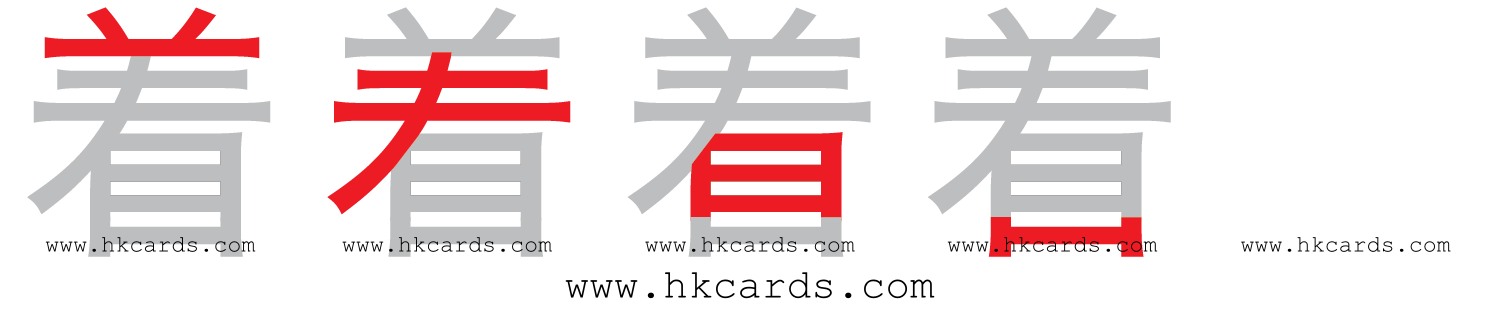
- 第五代倉頡輸入法 Cāngjié 5 input method: tqbu (廿手月山) (rime/rime-cangjie)
- 五筆字型 86 Wubi 86 input method: udh (rime/rime-wubi)
- 五筆字型 86 Wubi 86 input method: udhf (rime/rime-wubi)
- RIME-Moran input (auxiliary code): yo (rimeinn/rime-moran)
- 角號碼檢字法 Four-corner input method: 8060.4 8060.1 (Unihan_DictionaryLikeData)
- Mainland Telegraph: 4192 (Unihan_OtherMappings)
- Taiwan Telegraph: 4192 (Unihan_OtherMappings)
Education notes
- 808 Commonly Used CJK Characters: Yes (Trilateral Cooperation Secretariat, 2015)
- Hong Kong Primary School Grade (朗文初級中文詞典, 2001): 1 (Unihan_DictionaryLikeData)
- Korean Education Hanja: 2007 (Unihan_OtherMappings)
成語 Chengyu
This character appears in 17 imported Chengyu families.
Display:
- 一件落着 Japanese closure of a case, settlement of a matter Search corpus English Wiktionary Japanese Wiktionary
- 上不著天,下不著地 Contains this character in the attested form 上不着天,下不着地. Mandarin Cantonese Chinese to be suspended in midair Search corpus English Wiktionary English Wiktionary
- 不著痕跡 Contains this character in the attested form 不着痕迹. Mandarin Cantonese Chinese to leave no trace Search corpus English Wiktionary English Wiktionary
- 不著邊際 Contains this character in the attested form 不着边际. Mandarin Cantonese Chinese not to the point; wide of the mark; irrelevant; neither here nor there Search corpus English Wiktionary English Wiktionary
- 佛頭著糞 Contains this character in the attested form 佛头着粪. Chinese 美好的事物被玷污 Search corpus Chinese Wiktionary
- 吃不了兜著走 Contains this character in the attested form 吃不了兜着走. Mandarin Chinese to find oneself in serious trouble; to bear all the consequences Search corpus English Wiktionary English Wiktionary English Wiktionary
- 吃著不盡 Contains this character in the attested form 吃着不尽. Chinese 吃穿享用不盡,指生活富裕 Search corpus Chinese Wiktionary
- 差有差著 Contains this character in the attested form 差有差着. hak Chinese to leave a mistake uncorrected and have it turn out to be something good; a mistake turns out to be beneficial or useful Search corpus English Wiktionary English Wiktionary
- 心狂火著 Contains this character in the attested form 心狂火着. Hokkien Chinese to fly into a rage; to flare up; to lose one's temper Search corpus English Wiktionary English Wiktionary English Wiktionary
- 愛執染着 Japanese 異性に対する強い性欲の欲望に駆られること。 Search corpus Japanese Wiktionary
- 歪打正著 Contains this character in the attested form 歪打正着. Mandarin Cantonese Chinese to have used the wrong method or have had no intention of doing something but arrive at the correct result nevertheless Search corpus English Wiktionary English Wiktionary Chinese Wiktionary
- 猛著先鞭 Contains this character in the attested form 猛着先鞭. Chinese 勇往直前 Search corpus Chinese Wiktionary
- 猛著祖鞭 Contains this character in the attested form 猛着祖鞭. Chinese 勉勵人發憤圖強 Search corpus Chinese Wiktionary Chinese Wiktionary
- 矛盾撞着 Japanese 二つの事柄の間に齟齬があって、辻褄が合わないこと。 Search corpus Japanese Wiktionary
- 硬著頭皮 Contains this character in the attested form 硬着头皮. Chinese 不願意而勉強去作。 Search corpus Chinese Wiktionary
- 自家撞着 Japanese 自身の発言に自身の行動などが矛盾すること。 Search corpus Japanese Wiktionary
- 錯有錯著 Contains this character in the attested form 錯有錯着. hak Cantonese Chinese to leave a mistake uncorrected and have it turn out to be something good; a mistake turns out to be beneficial or useful Search corpus English Wiktionary English Wiktionary English Wiktionary
Dictionary indices
- Cihai T: 951.502 (Unihan_DictionaryIndices)
- Cowles: 184 (Unihan_DictionaryIndices)
- Fenn: 841A (Unihan_DictionaryLikeData)
- Fenn Index: 19.09 19.03 22.03 88.07 (Unihan_DictionaryIndices)
- HKGlyph: 2755 (Unihan_DictionaryLikeData)
- Han Yu: 53129.090 (Unihan_DictionaryIndices)
- IRGHanyu Da Zidian: 53129.090 (Unihan_DictionaryIndices)
- IRG 康熙 Kāngxī: 0808.051 (Unihan_DictionaryIndices)
- 康熙 Kāngxī: 0808.051 (Unihan_DictionaryIndices)
- Lau: 1388 (Unihan_DictionaryIndices)
- Matthews: 1258 (Unihan_DictionaryIndices)
- Meyer Wempe: 200 203 (Unihan_DictionaryIndices)
- Morohashi: 23339:E0102 (Unihan_DictionaryIndices)
- Nelson: 3665 (Unihan_DictionaryIndices)
- Phonetic class: 94 (Unihan_DictionaryLikeData)
- SMSZD2003Index: 462.04 538.21 (Unihan_DictionaryIndices)
- Zhongyuan Yinyun category: 照|歌戈撮|入作陽 (周德清, 1324; nk2028/zhongyuan-data, 2023)
- Zhongyuan Yinyun 中原音韻 final: 歌戈撮 (周德清, 1324; nk2028/zhongyuan-data, 2023)
- Zhongyuan Yinyun 中原音韻 initial: 照 (周德清, 1324; nk2028/zhongyuan-data, 2023)
- Zhongyuan Yinyun 中原音韻 xiaoyun: 着 (周德清, 1324; nk2028/zhongyuan-data, 2023)
- Zhongyuan Yinyun xiaoyun key: 着|照|歌戈撮|入作陽 (周德清, 1324; nk2028/zhongyuan-data, 2023)
Encodings & mappings
- CCCII: 226174 (Unihan_OtherMappings)
- CNS1986: E-3757 (Unihan_OtherMappings)
- CNS1992: 3-3757 (Unihan_OtherMappings)
- EACC: 226174 (Unihan_OtherMappings)
- GB0: 5537 (Unihan_OtherMappings)
- GB1: 5537 (Unihan_OtherMappings)
- Jis0: 3569 (Unihan_OtherMappings)
- Joyo Kanji: 2010 (Unihan_OtherMappings)
- Moji Joho: MJ018213 MJ018213:E0101 MJ018212:E0102 (Unihan_DictionaryLikeData)
- TGH: 2013:2398 (Unihan_OtherMappings)
- Unihan Core2020: GHJKMP (Unihan_DictionaryLikeData)
- Xerox: 264:111 (Unihan_OtherMappings)
Ideographic Research Group (IRG) sources
- IICore: AGJHKMP (Unihan_IRGSources)
- IRG_GSource: G0-5745 (Unihan_IRGSources)
- IRG_HSource: H-FED3 (Unihan_IRGSources)
- IRG_JSource: J0-4365 (Unihan_IRGSources)
- IRG_KPSource: KP0-ECB8 (Unihan_IRGSources)
- IRG_KSource: K0-7337 (Unihan_IRGSources)
- IRG_TSource: T3-3757 (Unihan_IRGSources)
Other
- SMSZD2003Readings: zháo粵zoek6 zhāo粵zoek6 zhe粵zoek6 (Unihan_Readings)